
Green Hydrogen Purification Using Temperature Swing Adsorption (DeOxo + TSA)
Recovery and purification of green hydrogen using the DeOxo + TSA process — catalytic oxygen removal followed by a temperature-swing dryer that delivers a fuel-cell-grade product from any electrolytic feed, with the regeneration energy recovered by design.
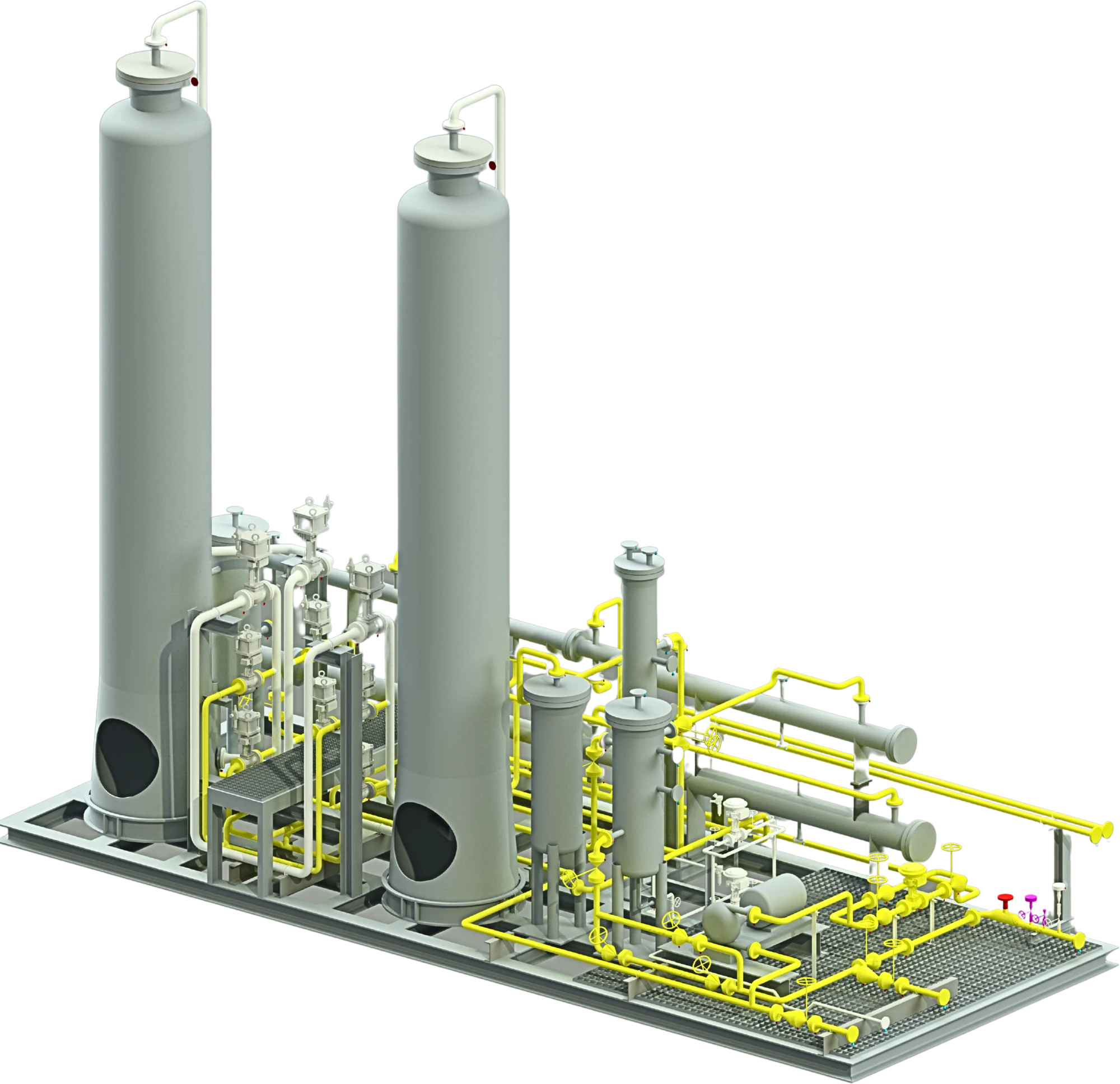
Decades of hydrogen purification — now applied to green hydrogen
Howe-Baker has designed, fabricated and commissioned hydrogen processing plant across generations of the industry — steam-methane reformers, PSA purification, TSA recovery and drying trains — delivered worldwide as engineered modular packages. Green hydrogen purification is not a new venture for us; it is the same discipline applied to a new feedstock.
- Full-scope EPC lineage. Engineering design, shop fabrication, procurement and commissioning under one roof — the skid arrives tested, not as a parts list.
- Adsorption across the portfolio. PSA, TSA recovery and molecular-sieve drying share one in-house knowledge base — adsorbents, cycle design, valve sequencing and regeneration control.
- Detailed design done in-house. Process simulation, time-resolved cycle modelling, mass balances, TEMA exchanger sizing, control narratives and line/valve sizing are produced by our own engineers — not outsourced around a vendor black box.
What You Get With Every Train
The heater bill is where a TSA lives or dies. We engineer the OPEX down.
Over a plant’s life the electric regeneration heater — not the vessels — dominates the cost of drying green hydrogen. Every Howe-Baker train is screened and can be selected on lowest annual operating cost, and three OPEX levers are engineered in from the first sketch.
Annual regeneration energy
The recuperated variants harvest the free DeOxo exotherm into the regeneration stream before the electric heater — around a fifth off the heater duty and the yearly energy bill at the reference design point, for the price of one gas-gas exchanger.
Desorption from the onset
With the bone-dry product purge of the catalogue scheme, water starts leaving the sieve at ~43 °C — every degree of heater ramp does useful work from the start, instead of paying sensible heat before desorption begins.
Selected on your OPEX
All four flowsheets are swept on one physics basis and ranked on installed cost, annual operating cost or total annualised cost — your criterion decides, with the energy ledger of every option on the table.
Further OPEX levers in every train: rate-controlled cool-down that spends no more purge than the thermal-shock limits require; regeneration scheduled by the adsorbent’s own isobar; two- or three-bed staggering to shrink vessels and their sensible-heat penalty; and electric heating sized on the true transient peak — never oversized “to be safe”.
Instrumented process flow — straight from our design system
Feed pre-heat, catalytic DeOxo, trim cooling and knock-out, twin-bed molecular-sieve drying and the regeneration loop — fully instrumented, exactly as we engineer it.
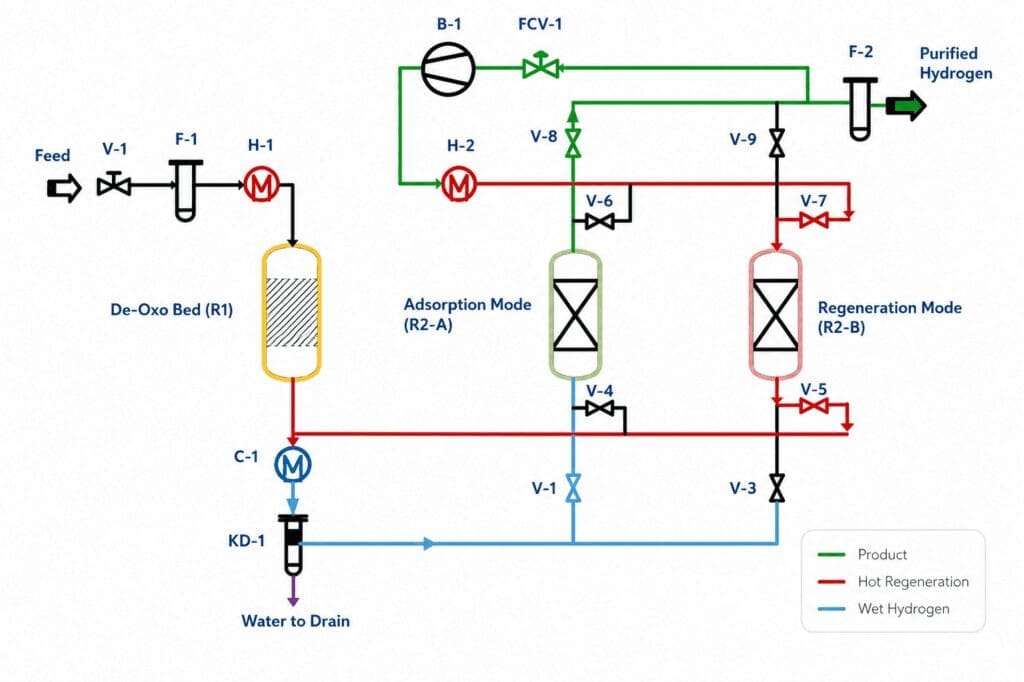
The two-tower cycle, live
Watch the duty swap in real time: wet hydrogen enters the top of the adsorbing tower and purified hydrogen leaves from the bottom, while the hot purge regenerates its twin — each vessel with its own dedicated inlet and outlet, exactly as the plant is piped. Bed colour shows water loading and temperature; the heater switches off for the cool-down, then the towers exchange duties.
Runs automatically. For the quantitative engineering view — bed temperature profiles, throttled purge flow and instantaneous cooler duty from the sizing model — open the full simulation.
Engineering Simulation ↗Every quotation is backed by physics you can audit
Behind each Howe-Baker TSA proposal sits a validated design engine — not a vendor rule of thumb. It sweeps thousands of candidate designs per architecture and sizes equipment on the real transients.
Time-resolved regeneration
A Schumann packed-bed transient tracks the thermal front through heat, soak and rate-limited cool-down — heaters, coolers and blowers are sized on true peaks, not cycle averages.
Measured adsorption equilibria
Dubinin–Astakhov or Langmuir isotherms, fitted to the adsorbent vendor’s data, drive the desorption window, its energy demand and the residual heel — selectable per project basis.
Transport & integrity checks
Péclet and dispersion verification of plug flow; Ergun pressure drop at hot and cold conditions; adsorbent and vessel-wall thermal-shock limits enforced on every candidate; regression-pinned results.
Wet or dry regeneration — selected on your operating cost
Wet regen + recuperator
- Slipstream of saturated feed — no blower
- DeOxo exotherm recovered into regen heat
- ~22% lower heater duty and energy bill
Dry regen + recuperator
- Bone-dry product recycle purge
- Desorption onset from ~43 °C
- Deepest dew points with heat recovery
Wet regen, no recuperator
- Simplest flowsheet, fewest exchangers
- Passive pressure-driven slipstream
- Best for small duties & fast delivery
Dry regen, no recuperator
- The catalogue scheme — minimum circuit
- Closed product-recycle loop with blower
- Chosen when spec margin rules
Guaranteed at the flange
| Parameter | Feed (electrolyser outlet) | Product guarantee |
|---|---|---|
| Hydrogen purity | ~99.7% (wet, with O₂) | ≥ 99.999% |
| Oxygen | 500 – 2,000 ppmv | < 5 ppmv |
| Water dew point | Saturated at battery limit | ≤ −60 °C |
| Operating pressure | 10 – 30 barg, turndown to 30% | |
| Configuration | 2-bed (1+1) or 3-bed (2+1) staggered TSA, fully automated changeover | |
| Adsorbent | Molecular-sieve spheres, 1.6 – 2.5 mm, ≥ 1,000-cycle end-of-run guarantee | |
| Regeneration | Electric, up to 290 °C — recuperated wet slipstream (reference) or dry product recycle (catalogue) | |
| Energy recovery | Gas-gas recuperation of DeOxo exotherm: ~22% lower regeneration OPEX at the reference point | |
| Delivery | Shop-fabricated modular skid: vessels, exchangers, valves, instrumentation, control narrative | |
Green hydrogen purification references
Green Hydrogen Purification
North Sea, UK · Europe
TSA De-Oxo followed by PSA polishing for electrolyser output — qualified to ISO 14687 grid quality.
Send us your electrolyser datasheet — we’ll return a sized, costed, energy-optimised Hydrogen Purification Unit.
Feed rate, pressure and product spec are enough to screen all four architectures, put a budget against each, and show you exactly where the regeneration energy goes — typically within days.
Request a Quote